Repairing vs. Replacing a Failing AC: Why We Never Push 'All or Nothing' Solutions
Repairing vs. Replacing a Failing AC: Why We Never Push 'All or Nothing' Solutions
The Myth of the Mandatory AC Replacement
If you are currently evaluating repairing vs. replacing a failing AC: why we never push 'all or nothing' solutions is a philosophy built entirely around protecting your comfort and your household budget. Throughout our years serving Copperas Cove, the team at Jormer Enterprises has seen a common industry myth persist—the idea that an aging, struggling air conditioner leaves homeowners with only one valid choice: an immediate, high-pressure, full-system replacement. This narrative often surfaces right when you are most vulnerable, dealing with a hot house and a malfunctioning unit.
Facing an AC breakdown is incredibly stressful, especially during the September late-summer to early-fall transition in Central Texas. The heat still lingers aggressively during the day, making a working air conditioner an absolute necessity. However, the impending transition to cooler weather fundamentally changes the urgency of the decision. You do not have to be backed into a corner by a technician demanding an immediate overhaul.
Instead of binary ultimatums, we find that a modern, ethical approach relies on tiered repair options. These options bridge the gap between a temporary patch to survive the remaining hot weeks and a massive long-term investment. By stepping back and having our team evaluate the actual condition of your equipment, you can base your next steps on transparent diagnostic criteria rather than a company's sales quotas. Our goal is to provide relief today while allowing you to plan strategically for tomorrow.
Understanding Late-Season System Fatigue
Air conditioners do not just randomly decide to quit; they are often pushed beyond their physical limits. Months of extended run-times in extreme heat compound the wear and tear on critical components. By the time September rolls around, your system has likely been running relentlessly since May. This relentless operation creates a phenomenon known as late-season system fatigue.
In our daily service calls across Central Texas, we find that late-season breakdowns are frequently the result of cumulative stress rather than a sudden, catastrophic failure. The ambient outdoor temperatures in Copperas Cove place an immense strain on older compressors, forcing them to work harder to reject heat into an already sweltering environment. When a system runs constantly, components like the capacitor, contactor, and fan motor endure sustained thermal and electrical loads that degrade their performance over time.
Understanding the root cause of this fatigue is the first step in determining if the system can be salvaged. If you are noticing longer cooling cycles, strange noises, or lukewarm air, troubleshooting late-summer system fatigue early can prevent a minor issue from snowballing into a major breakdown. Catching a struggling component before it fails completely gives you far more flexibility in how our technicians can address the repair.
Cumulative Wear vs. Terminal Failure
There is a massive difference between a tired electrical component and a permanently damaged compressor. A swollen capacitor or a pitted contactor is a symptom of cumulative wear—these are straightforward replacements that our team can perform to instantly restore your system's functionality. On the other hand, a compressor that has suffered internal mechanical failure or locked up entirely is a terminal issue.
Immediate diagnostics are absolutely critical before the system locks up completely. If a fan motor fails and you continue to run the system, the resulting heat buildup can destroy the compressor, turning a manageable repair into a forced replacement. Professional evaluation by our experts separates the minor fatigue issues from the fatal flaws.
Rejecting the Ultimatum: How Tiered Options Work
The standard operating procedure for many HVAC companies is to present two extreme paths: a wildly expensive repair that makes no financial sense, or a brand-new system installation. At Jormer Enterprises, our ethical framework is built on explicitly breaking down tiered choices without aggressive upselling. We contrast the "all or nothing" industry standard with a customer-first, educational approach that puts the power back in your hands.
When our technicians evaluate a struggling system, we rely on hard system performance metrics to build a range of solutions. One local homeowner recently reached out when their AC went out completely during a hot afternoon. Instead of demanding an immediate overhaul, our technician provided clear options for both a targeted repair and a full replacement. After reviewing the facts and the tiered choices, the customer ultimately chose to install a new unit because it made the most long-term sense for their family—and they noted it was a better, more reasonably priced unit than they had been offered elsewhere. The choice was theirs to make.
A tiered option framework typically looks like this:
1. The Band-Aid Fix: A minimal repair designed purely to get the system running for the next few weeks. This is ideal if you are waiting for fall weather to arrive before making a major decision.
2. The Bridge Repair: A more robust repair that addresses the immediate failure and stabilizes the system for another season or two, buying you time to save and plan for a future upgrade.
3. The Strategic Replacement: A full system swap, chosen not out of panic, but because the data shows it is the most logical, efficient, and reliable path forward.
Evaluating these options allows for better financial and comfort planning as the seasons change. You remain in complete control of the decision once presented with the facts, ensuring you never feel pressured into a corner.
Diagnostic Criteria: When a Patch Repair Makes Sense
In our experience, not all old systems are beyond saving; the viability of a repair depends entirely on the integrity of the core components. Our technicians do not guess whether an air conditioner will survive the rest of the season—we measure it. We share exact diagnostic readings with you to ensure complete transparency, proving that our recommendations are based on data.
Specific readings indicate whether a system still has life left in it. For example, system performance metrics like compressor amp draw and refrigerant leak severity tell the true story of your unit's health. Minor refrigerant leaks or simple electrical component swaps can serve as highly viable bridge repairs, especially when the goal is simply to carry the home into the cooler months.
Key Metrics That Support Repair
• Compressor Amp Draw: A healthy compressor amp draw indicates that the heart of the system is stable. If our meters show the compressor is pulling the correct amperage without struggling or overheating, the mechanical core is sound.
• Leak Severity: Manageable, localized refrigerant leaks (such as a loose fitting or a small pinhole) can often be repaired or topped off, whereas systemic, widespread coil failure usually dictates replacement.
• Structural Integrity: The overall condition of the air handler, blower motor, and ductwork must be solid. If we inspect the indoor unit and find it free of severe rust and biological growth, repairing the outdoor unit makes more sense.
Pros and Cons of a Patch Repair:
• Pro: Lower immediate upfront investment.
• Pro: Restores cooling quickly during a hot September afternoon.
• Pro: Buys valuable time to plan and research a future replacement.
• Con: Does not improve the overall energy efficiency of an older system.
• Con: Carries a risk that a different, aging component may fail next season.
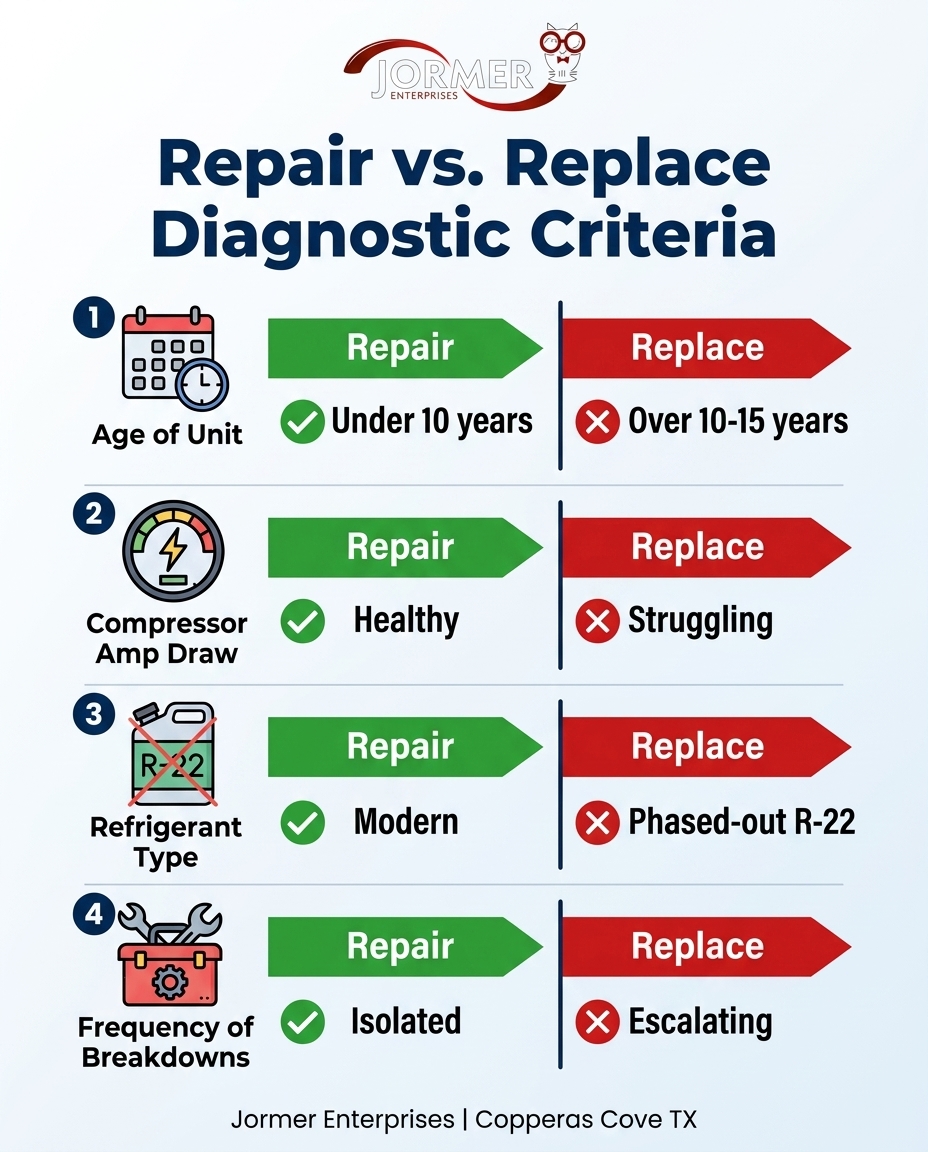
Repair vs. Replace Diagnostic Criteria
When Replacement is the Most Logical Path
While our team advocates strongly for tiered repairs, we also know from years of field experience that there are objective scenarios where a full replacement is genuinely the best option. Maintaining trust means explaining the "why" behind a replacement recommendation just as thoroughly as a repair. Another customer facing the brutal Texas heat recently needed a complete AC unit replacement. Because our team guided them through the data rather than rushing them, the process was easy and stress-free, resulting in a highly satisfactory upgrade.
Certain red flags make patch repairs a poor investment. Frequent, escalating breakdowns suggest that the system is in a state of cascading failure. Furthermore, air conditioners in extreme heat climates typically have a shorter lifespan of 10-15 years due to the sheer volume of hours they run annually. Pushing a system past this point often results in diminished comfort and inflated utility bills.
The type of refrigerant your system uses is another major factor we evaluate. Older systems utilizing phased-out R-22 refrigerant face distinct compatibility and sourcing challenges. Because R-22 is no longer manufactured, any repair requiring a refrigerant recharge becomes disproportionately expensive. In these cases, securing a reliable new system before the next major cooling season is much safer than risking a complete, unrepairable failure.
The Limits of the 50% Rule
The traditional HVAC rule of thumb states that if a repair costs half the value of the system, replacement is advised. However, we always tell our customers that this rule requires nuance. You must factor in system age and energy efficiency gains. Spending 30% of the cost of a new system on a 14-year-old unit is still a poor investment because the unit will likely fail again soon. Conversely, upgrading to a new system often unlocks significant efficiency savings, and federal tax credits may apply to qualifying high-efficiency heat pump installations (though you should always consult a tax professional for specific eligibility).
• System Age — Favoring a Bridge Repair: Under 10 years old — Favoring a Full Replacement: Over 10-15 years in extreme heat
• Refrigerant Type — Favoring a Bridge Repair: Modern refrigerants — Favoring a Full Replacement: Obsolete R-22 refrigerant
• Breakdown History — Favoring a Bridge Repair: First major issue in years — Favoring a Full Replacement: Multiple failures in the past 24 months
• Compressor Health — Favoring a Bridge Repair: Normal amp draw, runs smoothly — Favoring a Full Replacement: High amp draw, overheating, hard starting
Weighing Efficiency and Impending Fall Weather
Synthesizing the timing aspect of your decision is critical. When an air conditioner struggles in late September, you are fighting the calendar just as much as the equipment. The rapid transition from intense heat to mild fall weather characteristic of Central Texas plays a major role in your strategy.
The significant drop in temperature that usually arrives in October drastically reduces the immediate load on your AC. Surviving September might be all a struggling system needs to do before resting for the winter. If our technicians can perform a minor bridge repair to get your unit through the next few weeks, you successfully avoid a crisis.
Using the fall transition to plan a replacement offers massive advantages. You avoid the panic of a mid-summer emergency, you have time to research different brands and efficiency ratings, and we can schedule the installation when the weather is mild enough that being without AC for a day is perfectly comfortable. Taking a measured, tiered approach provides true peace of mind, knowing you made a data-driven choice for your Copperas Cove home.
Frequently Asked Questions About AC Repair and Replacement
When should you replace your AC instead of repairing it?
You should replace your AC when the cost of repairs becomes a recurring burden, or when the system is over 10-15 years old and uses obsolete R-22 refrigerant. A replacement is also the smartest path if the compressor is failing or if the unit can no longer maintain comfortable indoor temperatures during normal summer weather. Evaluating your system's overall efficiency and repair history will guide you toward the most logical long-term investment.
Is it worth fixing an old AC at the end of summer?
Fixing an old AC at the end of summer is often worth it if the repair is a minor, inexpensive electrical fix that serves as a bridge to cooler weather. A small patch can keep your home comfortable through September, allowing you to carefully plan a full replacement during the mild fall months. However, if the late-summer failure involves a blown compressor or a massive refrigerant leak, investing heavily in a dying system is not recommended.
Is it worth repairing a 15-year-old AC?
Repairing a 15-year-old AC is rarely recommended unless the fix is exceptionally minor, such as swapping out a standard capacitor or clearing a drain line. Systems of this age in extreme heat climates have typically reached the end of their mechanical lifespan and suffer from severely degraded energy efficiency. Pouring significant funds into a 15-year-old unit usually delays an inevitable replacement by only a few months.
How long do AC units last in Texas?
Based on what our technicians see in the field, air conditioning units in Texas typically last between 10 and 15 years, which is slightly shorter than the national average. The extended, brutal cooling seasons force local systems to run thousands of hours more per year than units in milder climates. Regular, professional maintenance can help push a system toward the 15-year mark, but the extreme ambient heat inevitably accelerates mechanical wear and tear.
Should I replace my AC before it fails completely?
Replacing your AC before it fails completely is a highly strategic move that prevents emergency breakdowns during peak heat waves. Proactive replacement allows you to research equipment options, secure financing, and schedule the installation at your convenience. Waiting for a catastrophic failure often leads to rushed decisions and uncomfortable days spent waiting for equipment to arrive.
Can a minor AC repair get my system through the rest of the year?
Yes, a targeted minor repair can absolutely get a struggling system through the remainder of the cooling season. Addressing issues like a failing contactor, a clogged filter, or a weak capacitor can stabilize the unit just long enough for the fall weather to arrive. This bridge strategy is one of the most effective ways to delay a major purchase until you are fully ready to upgrade.
Make Your Next AC Move With Confidence
You do not have to face an "all or nothing" ultimatum when your air conditioner starts to fail. The lingering heat in Copperas Cove can make a breakdown feel like an emergency, but you always have choices. By relying on our transparent diagnostic criteria, you can clearly see whether a band-aid fix, a bridge repair, or a full replacement makes the most sense for your specific situation.
Do not let a struggling system dictate your comfort as the season changes. Schedule a comprehensive diagnostic visit with our team to get a transparent breakdown of your equipment's performance and lifecycle metrics. With the right data in hand, you can secure your home's comfort and make your next AC move with total confidence.
Sed iaculis aenean sit sed risus arcu vitae integer elit.
5 min read
That Burning Smell During Your First Fall Heater Startup: What It Is and When to Call Us
When the first October cold snap hits and you turn on your heater, a sudden burning odor can cause immediate panic. Find out if it's harmless dust burn-off or a serious mechanical issue.
Repairing vs. Replacing a Failing AC: Why We Never Push 'All or Nothing' Solutions
An aging air conditioner struggling at the end of summer doesn't always require a full replacement. See how our tiered approach gives you real choices without the high-pressure sales pitch.
HVAC Maintenance Tips: Troubleshooting Late-Summer System Fatigue
Why your AC runs constantly without cooling. Use our home maintenance tips and troubleshooting for late-summer fatigue to decide when to call a professional.